
A small sailboat keeps its course beneath an enormous disembodied head. A winged monster peers out of the dark, visibly afraid. A skeleton rides with its sword raised. In Odilon Redon’s drawings and lithographs, the strangest figure in the picture is often the one that does the looking.
Redon (1840–1916) called his charcoal drawings his noirs. Charcoal could be lifted from the paper to recover a light or rubbed until an outline dissolved. On the lithographic stone he found ways to carry those effects into print. These twelve works follow the uses he made of black across two decades, from the blank air around an apparition to the close-packed shadows of the Apocalypse.
Contents
Apparitions Above the Horizon
The little sail establishes the scale of Guardian Spirit of the Waters. It sits low on the water, a pale triangle beneath a head so large that its features would be difficult to take in from the deck. Redon gives the boat a navigable sea and leaves the head suspended above it. What passes between them depends partly on a word. The title identifies the head as a guardian. Its protection looks much like surveillance from the far side of the water.

Charcoal drawing · View print
In Eye-Balloon, made the same year, the eye has a direction of its own. The pupil turns upwards, away from the marsh and from the small head borne beneath it on a platter. Only the spectator can take in all three at once. The lashes stand out with extraordinary precision against a sky worked with rubbed and lifted charcoal. At the rim of the balloon we can trace the contour of a solid object. A little way beyond it the same substance has become air.

Charcoal and chalk on coloured paper · View print
The New York drawing measures barely more than forty centimetres in height. That intimacy matters. Its changes of pressure and its erasures are legible at the distance from which one might read a page. Four years later Redon returned to the motif for a lithographic album dedicated to Edgar Allan Poe. The drawing reproduced here preserves the earlier encounter with the texture of the paper.
Three Encounters in the Printed Albums
Gnome appeared in Redon’s first lithographic album, Dans le rêve, in 1879. The head has the gravity of a portrait until one follows the ears outwards. They extend into thin, winglike membranes. With no shoulders below, those slight protrusions carry much of the weight of the composition. The face is easy to recognise and unusually hard to place. Even its distance from the viewer is uncertain.

Lithograph from Dans le rêve · View print
A reader turning the pages of Redon’s 1885 album Hommage à Goya would encounter a different order of strangeness. In its third plate, A Madman in a Dismal Landscape, a bearded man stands between two massive tree trunks. His arms are folded. The wide-open eyes are almost the only mobile part of him. The trunks crop the hills on either side, leaving him a narrow strip of ground in which to stand. The caption supplies a judgement about the man that the landscape gives us little means to test.
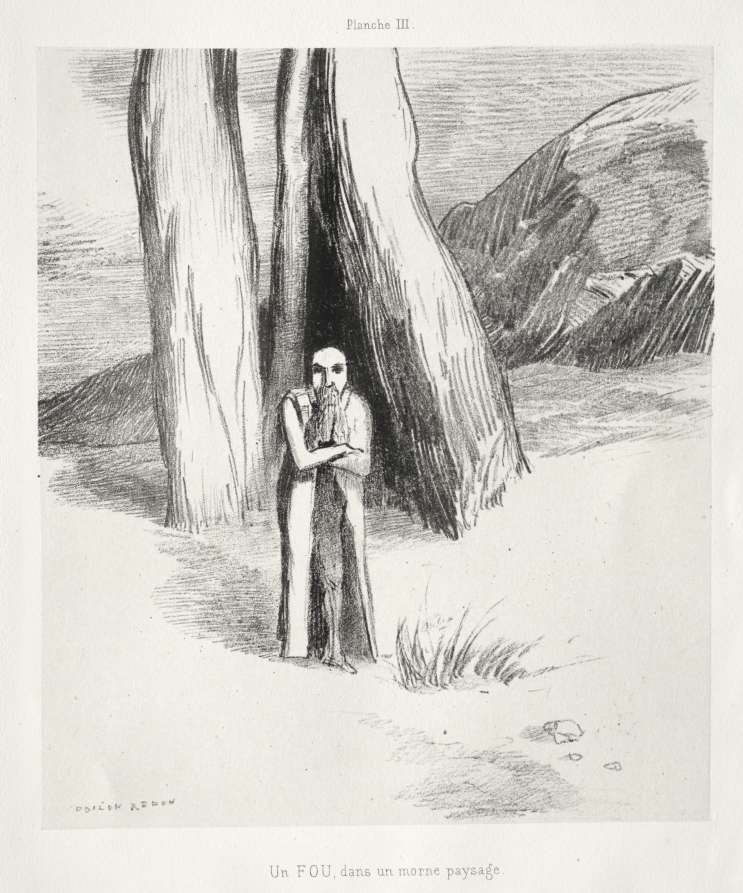
lithograph on China paper laid on wove paper · Cleveland Museum of Art
Another sheet in that same Goya album bears the curious title There Were Also Embryonic Beings. The word “also” makes it sound as though a witness has remembered one further detail. Near the top a rounded head peers from a bristling enclosure. Lower down a pale face is just discernible. The grain of the printed ink is dense enough to conceal where either body might begin. One seems to have arrived in the world a little earlier than the other.
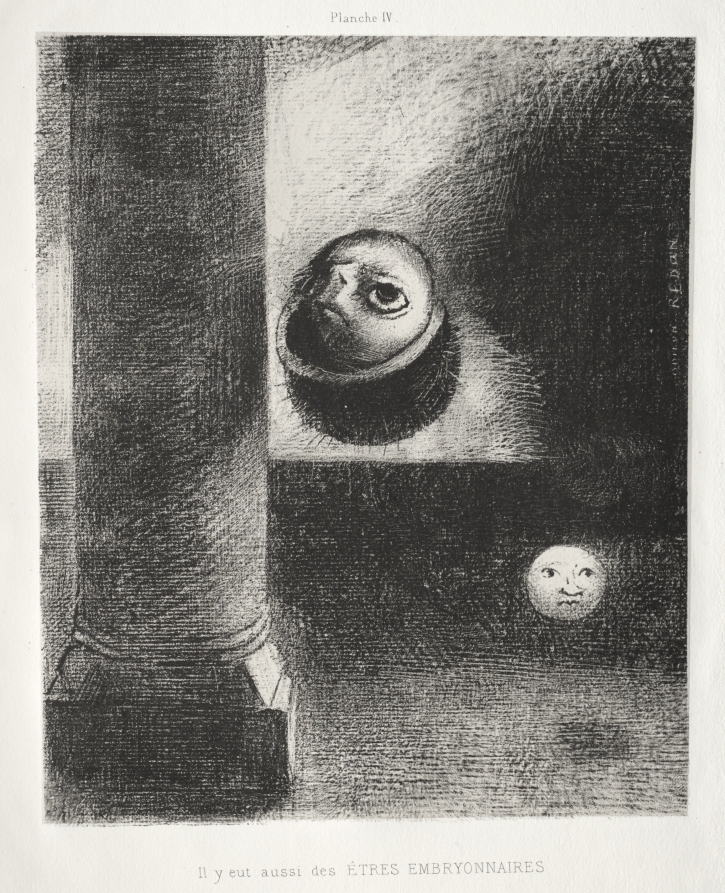
Lithograph on China paper laid on wove paper · Cleveland Museum of Art
How a Spider Acquires an Expression
The two spiders make a small experiment in portraiture. Trace a leg from its narrow tip through its abrupt changes of direction to the dark mass of the body. There is enough information in that one line to imagine how the animal moves. Recognition of the face brings a second, conflicting kind of knowledge. A creature one might instinctively brush aside appears capable of registering the insult.

Drawing · View print
In The Crying Spider, attention settles on the lowered features at the centre of the body. Once we have registered distress, the same thin legs that made the animal so easy to recognise look inadequate to its weight. The smiling creature offers a useful test of how much we have supplied. Its mouth opens across the dark body, and the legs appear to spread with something like assurance.

Lithograph · View print
Several versions of the spiders survive. Redon drew a smiling spider in 1881 and revisited the subject in the 1887 lithograph reproduced here. The distinction matters particularly around the body. On a drawing, charcoal sits directly on the sheet. In the lithograph it is the distribution of printed ink, and the small reserves of light between its marks, that give the body its bristling edge.
The Frightened Monster
The creature in The Chimera Gazed at All Things with Fear has a wing broad enough to shelter a human figure. Yet the small lights on its nose and brow lead to a face with parted lips and startled eyes. Redon has given the creature usually charged with frightening us an excellent view of something outside the picture. The sheet leaves us to imagine what could alarm a chimera.

lithograph on China paper laid on wove paper · Cleveland Museum of Art
Printed in 1888 for the first of Redon’s three albums after Gustave Flaubert’s The Temptation of Saint Anthony, the man-headed fish comes with a remarkably explicit caption. It seems to promise that the creature can be identified feature by feature. Looking undoes that certainty. A strongly marked human profile gives way to a body built out of short, coarse strokes, ending in a pair of pale fins. The large eye has almost as much in common with the small round forms in the surrounding space as it has with the face.

Lithograph · Cleveland Museum of Art
The Brussels publisher Edmond Deman commissioned the album after encountering Redon’s work there in 1886. Flaubert supplied a hermit beset by visions. On the printed sheet the hermit need never appear. The reader who opens the album takes his place in front of the apparition.
What the Hermit Sees
In Everywhere Eyeballs are Aflame, from the same 1888 album, a single globe dominates the pale space above a crag. The title promises a multitude. The artist shows one eye so insistently that it is difficult to look elsewhere. Follow the fine strokes radiating from its rim and the organ begins to resemble a living burr. Ten years after Eye-Balloon, Redon could dispense with the rigging and still make an eye hang convincingly in the air.
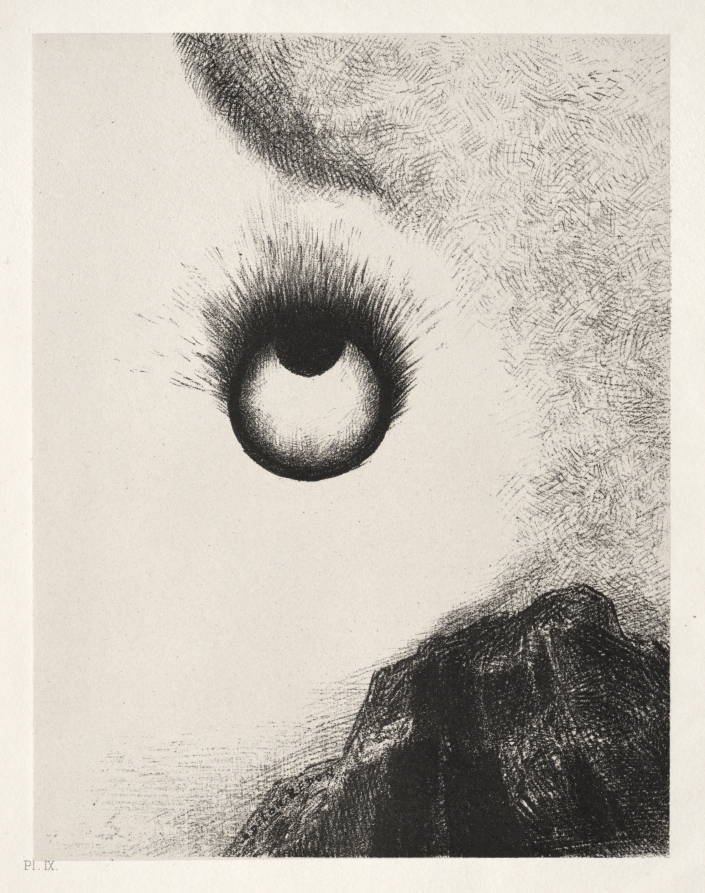
lithograph · Cleveland Museum of Art
In another of Anthony’s visions, the Devil carries the Seven Deadly Sins under his wings. Redon concentrates the light on the little bodies gathered in his hands. The bearer takes longer to make out. Two horns emerge, then the shadowed profile and the extent of the wings. The disproportionately small figures make the Devil immense, much as the sail did for the guardian above the water. Here the little figures are already within his grasp.

lithograph · Cleveland Museum of Art
The Rider in the Apocalypse
For his 1899 album after the Apocalypse of Saint John, Redon gave Death a horse, a sword and scarcely enough light to distinguish rider from mount. In And His Name That Sat on Him Was Death, the skeleton leans back even as the horse moves forward. The raised weapon holds that contrary motion for an instant. A long diagonal cuts across the field of black marks, giving the eye a sharp bearing in the tumult.
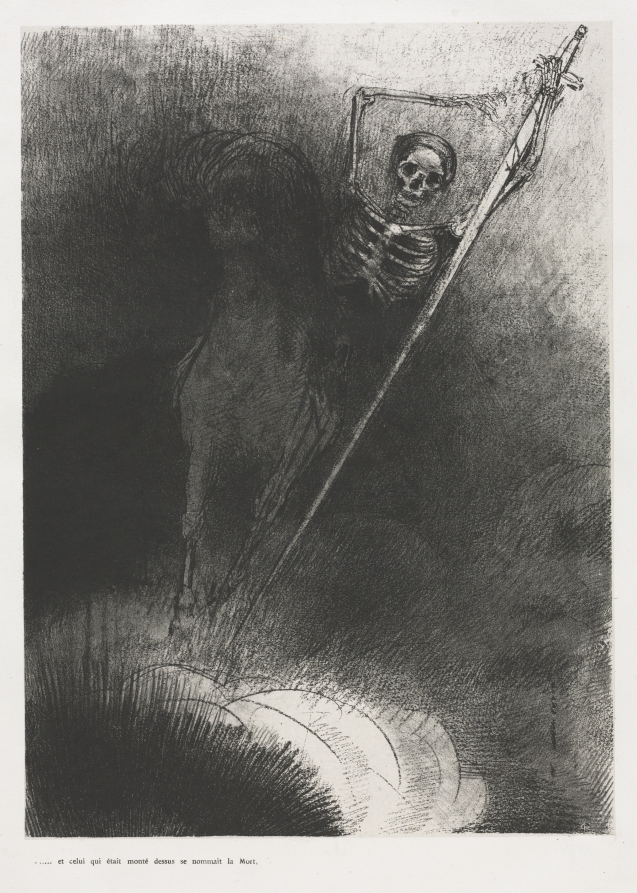
lithograph · Cleveland Museum of Art
The pale curves below the horse are among the clearest marks on the page. They give the dense passage above them its speed, just as the still water in the early Guardian Spirit gave a floating head its scale. Over twenty years separate the two images. In both, Redon reserved a little ordinary evidence of the physical world for the moment when his subject most threatened to escape it.
Collection notes and further reading
Museum illustrations are courtesy of the Cleveland Museum of Art’s open-access collection. Their captions link to individual catalogue records.