
In 1893, visitors crowded around a painting of a woman with a snake. The work was called The Sin, and its reputation could send people hurrying through an exhibition to see it. Years later, the writer Hans Carossa recalled just such a visit in his autobiographical novel: the gathering of spectators, the imposing gold frame, the pale body almost swallowed by darkness. The Neue Pinakothek's account of the painting preserves his description. Stuck had made an image people wanted to see for themselves.
That is a good place to begin with Franz von Stuck. His paintings are often described as mysterious, but their initial appeal is remarkably direct. A face catches your attention. A snake appears where you expected hair or clothing. Two people embrace, and a closer look reveals that one of them has an animal's body. You understand the situation quickly; understanding your reaction takes longer.
These seven paintings follow him from his early religious subjects to the quieter Falling Stars. They also reveal how much gets lost when he is treated simply as a painter of beautiful nightmares. There are old legends to untangle, exhibition scandals to revisit, and small decisions about colour and posture that explain why his pictures stay in the mind.
A Designer Learns To Command Attention
Before he painted the pictures that made him famous, Stuck earned his living designing illustrations and decorations. Born in 1863, the son of a Bavarian miller, he studied in Munich and contributed drawings to publications including Allegorien und Embleme and the humorous magazine Fliegende Blätter. His breakthrough came in 1889, when The Guardian of Paradise won a medal at Munich's international art exhibition. The Museum Villa Stuck chronology records how quickly recognition followed.
His training as a designer is worth remembering when you look at the paintings. He rarely needs a room full of objects to establish a mood. A strong outline, a dark background and one carefully placed highlight can do the work. Even when the subject is complicated, the picture remains easy to grasp at a distance. Come closer, and the expression becomes harder to pin down.
In 1892 he helped found the Munich Secession. The following year he designed its poster featuring the head of Pallas Athena, while The Sin became a sensation at its first exhibition. His association with Symbolism makes sense in this setting. For a Symbolist painter, a myth could give visible form to something difficult to describe: desire, dread, a religious experience. The serpent and the sphinx brought familiar stories with them, but Stuck used them to ask uncomfortable questions about human behaviour.
Lucifer: The Silence After The Fall
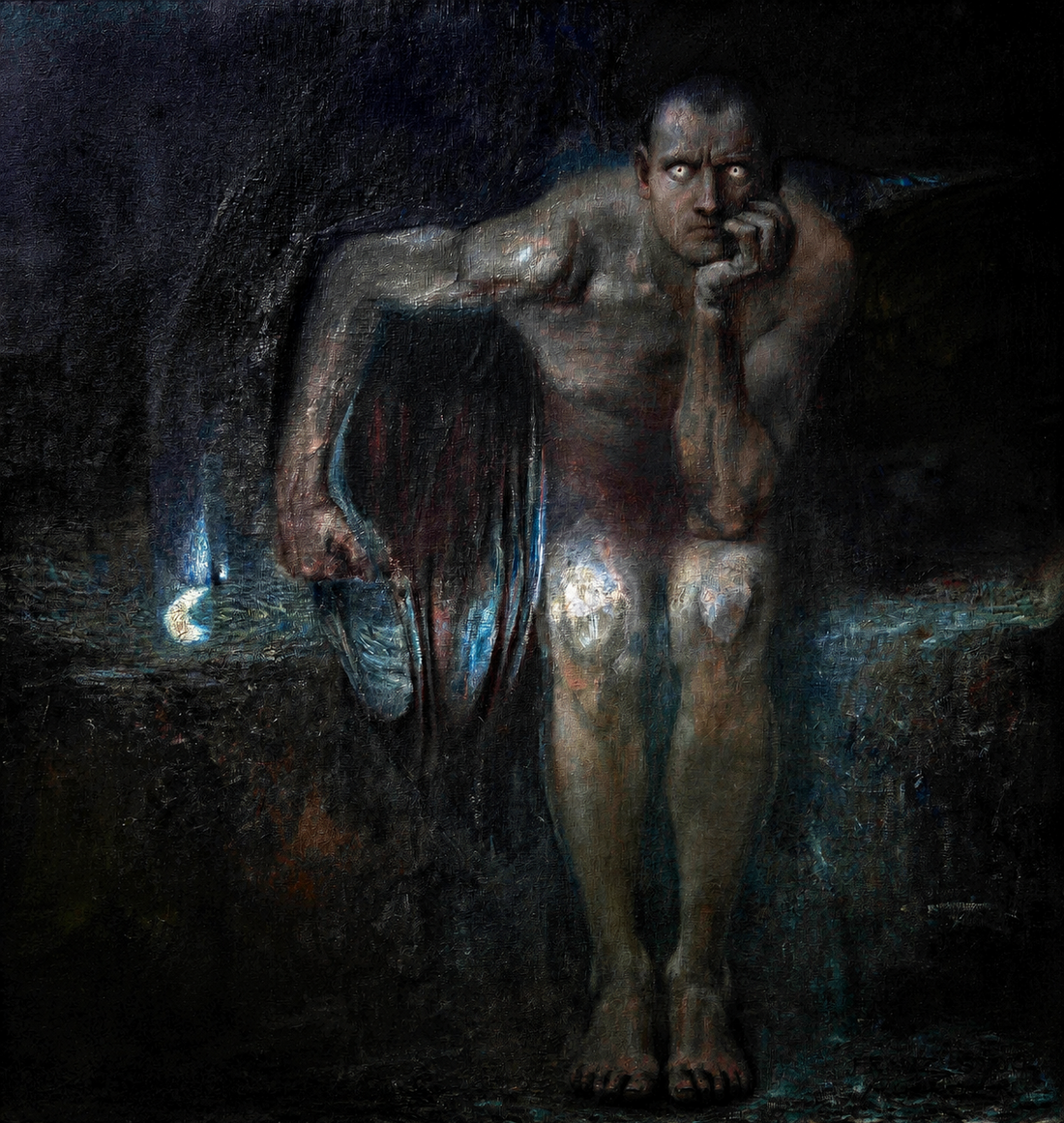
Start with the hand beneath Lucifer's chin. It is a familiar pose: someone absorbed in thought, perhaps tired, perhaps angry. Stuck gives it to a fallen angel and allows the ordinary gesture to become threatening. The figure has enormous physical strength, yet sits folded into himself. His eyes meet ours with an intensity that the rest of his body seems to hold in reserve.
Painted around 1890, Lucifer found a royal buyer almost immediately. Prince Ferdinand of Bulgaria purchased it in Munich in 1891. It remains in the Bulgarian National Gallery's collection. In its 2024 exhibition Between Light and Darkness, the gallery reunited it with The Guardian of Paradise, Stuck's successful painting of the previous year. The pairing helps explain how early he was working with opposing images of spiritual power.
The title identifies the figure, but Stuck supplies very little narrative. We do not see the fall from heaven or the action that caused it. Instead, we have to spend time with the person left behind. That decision makes the picture unusually intimate. A spectacular battle would give us something to watch; this seated figure gives us someone to face.
Look at how little light Stuck needs. The cold gleam of the eyes draws attention before the surrounding forms are fully clear. The faint blue light at the left makes the darkness feel inhabited without explaining its depth. The wings are difficult to separate from the shadows. Your eyes adjust gradually, as they might on entering a dark room, while Lucifer's stare is already waiting.
It is possible to read the pose as wounded pride, exhausted anger or patient calculation. Those are interpretations rather than a documented statement of Stuck's intention. What the painting makes certain is the physical tension: the bent body is still, the gaze is active. Spend a moment looking away from the face and at the shoulders and knees. The menace survives even when the eyes are no longer your focus.
The Vision Of Saint Hubert: A Light Among The Trees
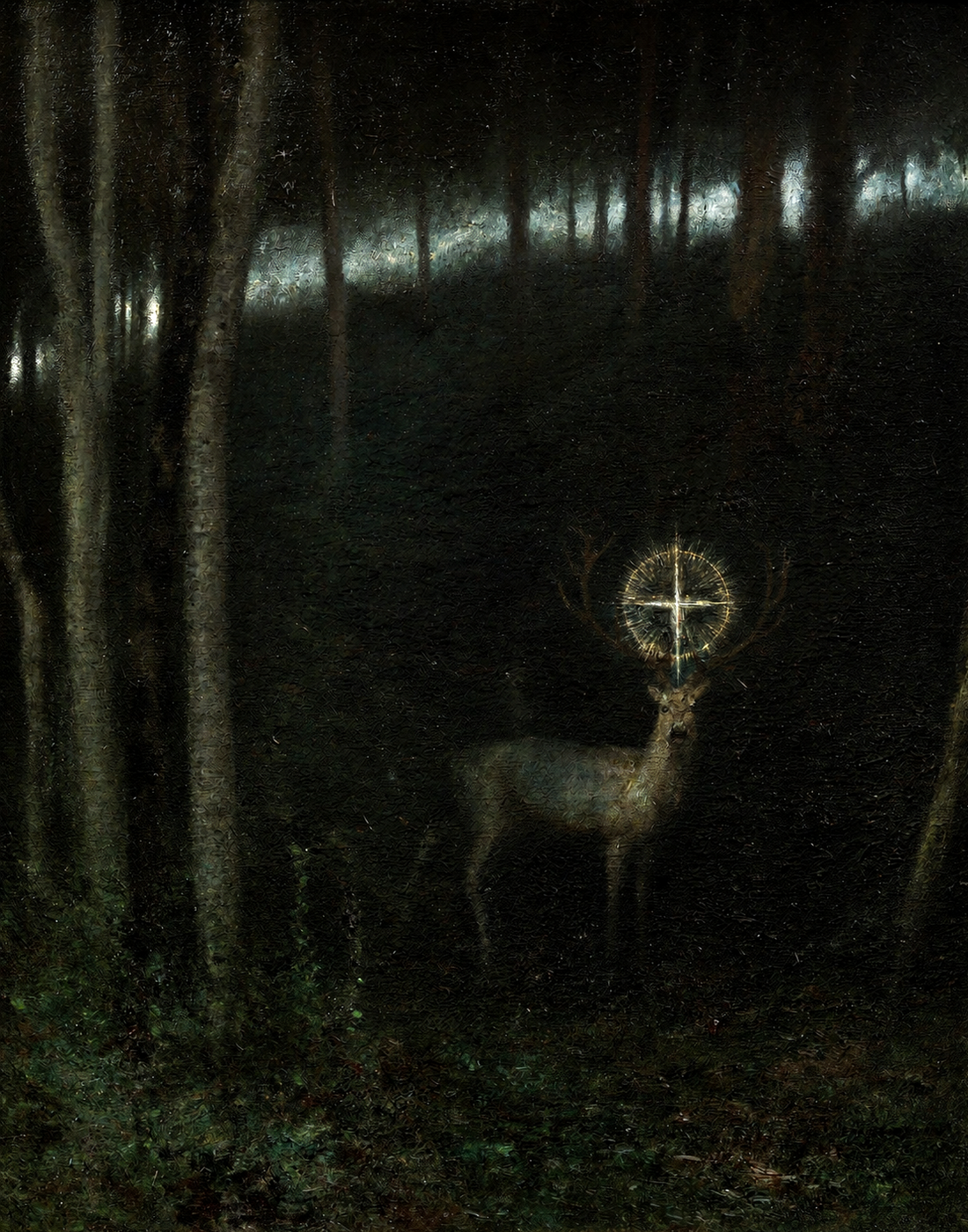
The stag is an unlikely bearer of a religious revelation. Its legs are planted on the forest floor; its body belongs to the same woodland as the trees around it. Then you notice the cross between its antlers. Stuck makes the impossible event grow out of an otherwise recognisable encounter with an animal.
According to the legend, Hubert was hunting when Christ appeared to him between a stag's antlers. The experience led to his conversion. There is an interesting complication in the story's history: the National Gallery in London explains that images of Hubert's vision appeared centuries after his death, probably through the merging of his legend with that of Saint Eustace. Artists inherited a story that had already changed in the telling.
Earlier painters often showed the encounter as a busy scene, with the hunter kneeling, dogs reacting and a horse being restrained. Stuck leaves the animal and the light to carry the subject. There is no need to follow a crowd of figures to discover the important event. We seem to have stepped into the wood ourselves, just as something extraordinary becomes visible.
The Museum Villa Stuck dates this painting to 1890; its catalogue gives a canvas size of 62.5 by 53 centimetres. It is a relatively intimate work. The narrow trees and enclosed space suit that scale: this is a vision encountered at close quarters, rather than a spectacle unfolding across a grand landscape.
The small area of radiance does much of the work. If the whole forest were brightly lit, the cross would lose its startling effect. Instead, Stuck makes you search through the trees and then holds your attention between the antlers. Seen after Lucifer, the painting also offers a useful correction to his reputation. Darkness could make a sacred encounter convincing just as readily as it could suggest danger.
Medusa: The Monster Who Seems Afraid
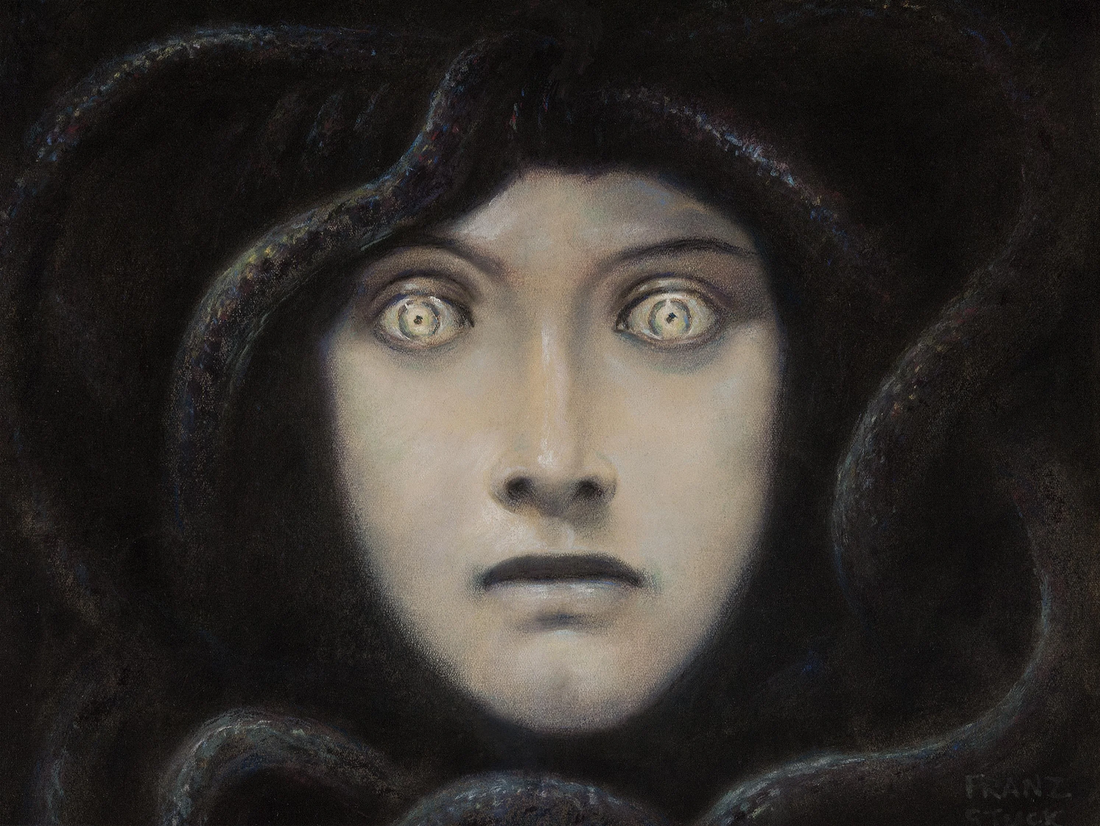
Medusa is supposed to terrify the person who sees her. Here she looks as though she has seen something terrible herself. The eyes are wide, the lips parted, the pale face surrounded by snakes. For a moment, before you take in those snakes, her expression can register simply as human shock.
The Germanisches Nationalmuseum's discussion of the 1892 painting identifies Arnold Böcklin's treatment of Medusa from 1878 as an important precedent. It also draws attention to this double impression: the head inspires fear while seeming to experience it. Stuck was working with an established subject, but the emotional uncertainty gives his version its particular grip.
In Greek mythology, Medusa is one of the Gorgons, and her gaze turns those who look at her to stone. That makes a painting of her face an especially pointed choice. We are doing exactly what the story tells us is dangerous. Stuck intensifies the encounter by giving us so little else to look at. There is no distant landscape or extended action to provide relief.
The snakes are easiest to appreciate on a second look. At first they form a dark border around the skin, almost like an elaborate arrangement of hair. As their bodies become distinct, the frame around the face becomes alive. That delayed recognition matters. We have already responded to the expression before fully registering the creature to whom it belongs.
The museum places this image within the late nineteenth-century fascination with threatening female beauty. That context explains part of its appeal to Stuck's audience, but it does not exhaust what is in front of us. The face can look vulnerable as well as dangerous. Try looking first at the eyes, then at the mouth: the balance between alarm and aggression shifts. The painting gives us no hero to reassure us that the monster has been understood and defeated.
The Sin: Beauty That Refuses To Explain Itself
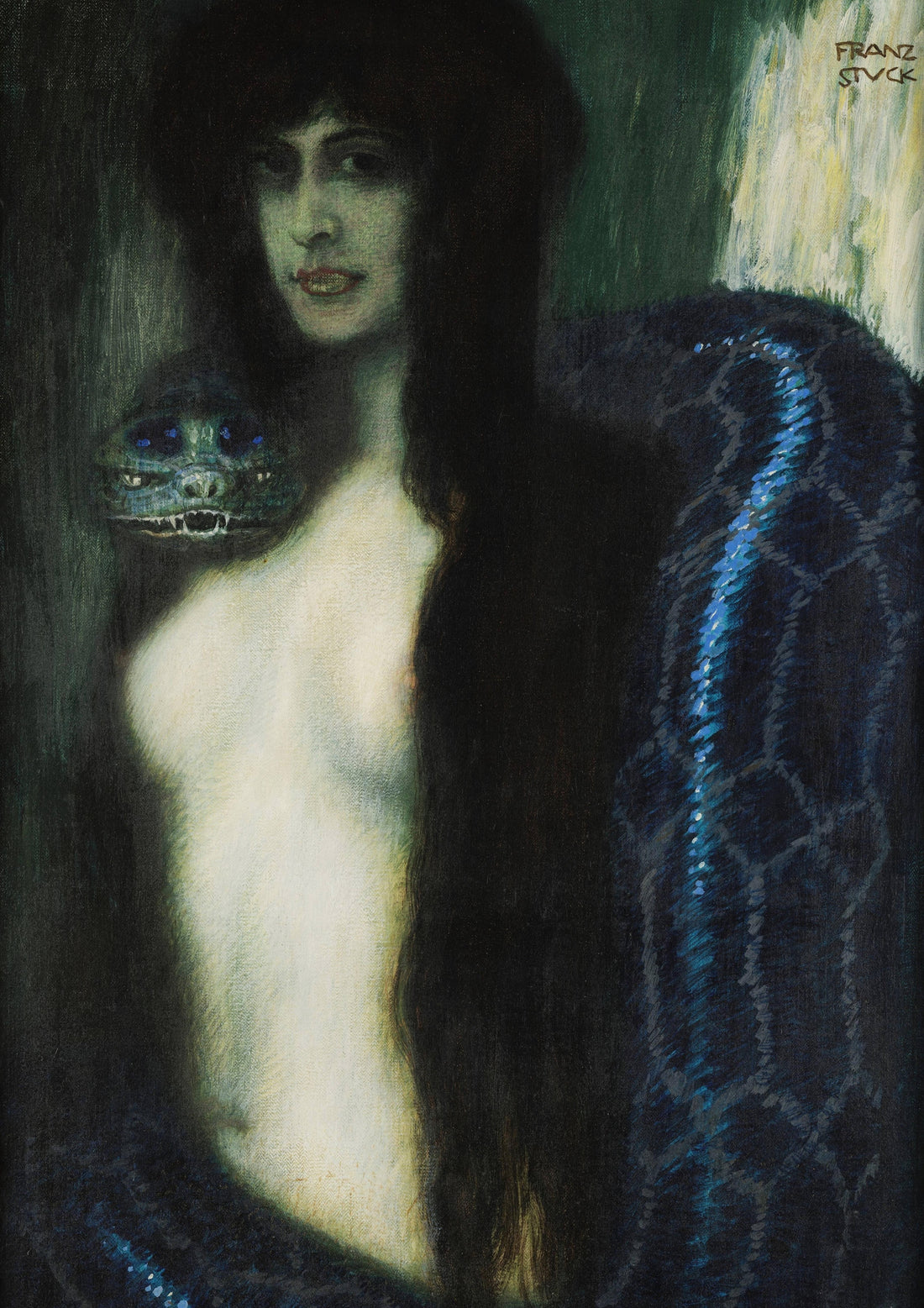
The snake in The Sin takes a moment to become fully visible. Its patterned body curves around the woman's shoulders with the weight and sweep of a luxurious wrap. Then its head appears beside hers. What first looked like part of her adornment becomes a second creature looking out of the picture.
Stuck returned to the subject repeatedly. The Neue Pinakothek owns the celebrated 1893 version and records a series of related compositions made between 1891 and 1912. The image reproduced here belongs to that recurring subject; an exact date should not be borrowed from another version simply because the arrangement looks familiar.
There is a revealing clue in an earlier title. A preparatory etching from 1891 was called Die Sinnlichkeit, or Sensuality, as the Berlin museums' catalogue explains. The change in emphasis matters. 'Sensuality' describes an experience; 'sin' gives it a moral judgement. The woman and serpent invite thoughts of Eve and temptation, but Stuck has removed the garden, the fruit and the surrounding story. The encounter is reduced to a body, two faces and a loaded title.
The picture also had a surprising role in Stuck's home. He installed a version in the centre of the elaborate artist's altar in his studio. Beneath it stood sculptures including The Dancer, with the features of his wife Mary, and The Athlete, treated as a self-portrait. The Villa Stuck's account of the room describes the arrangement as dedicated to art and Eros. A supposedly sinful image had been given the most honoured position in the house.
That setting makes a straightforward moral warning difficult to sustain. Stuck was clearly interested in the attraction of the image as well as the danger it implied. Notice how the woman barely needs to act. She does not reach towards us or perform an obvious gesture of seduction. Her stillness leaves the spectator to do the looking, and to notice the unease mixed into that pleasure. The painting's historical assumptions about women are open to criticism; its ability to expose a conflicted act of looking remains compelling.
The Kiss Of The Sphinx: An Embrace At The Edge
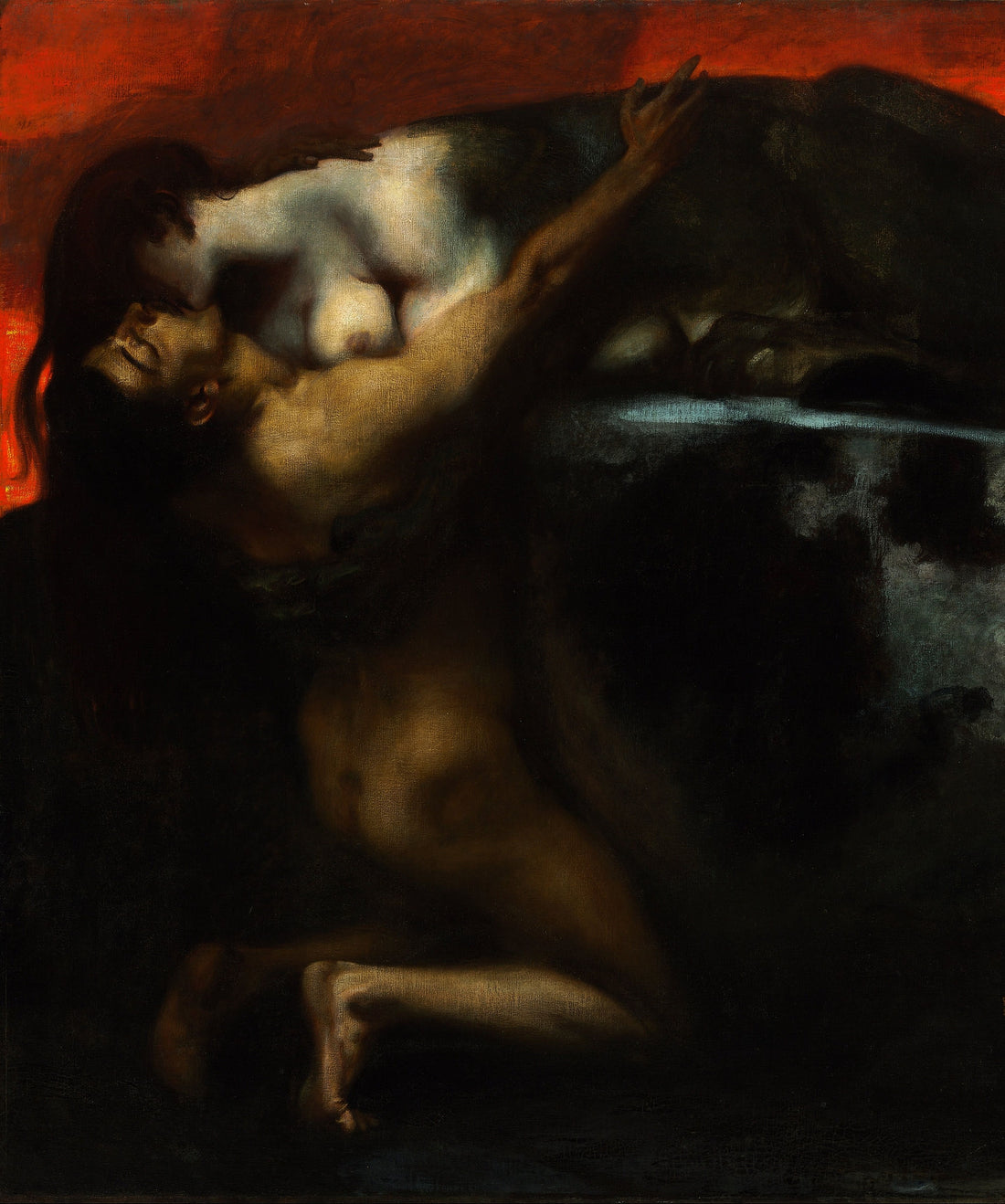
The man's posture tells the story before the title does. He kneels and stretches upwards, his back bent and his body drawn towards the sphinx. She occupies the higher position. Their faces meet, but the weight of her animal body changes the meaning of the embrace. It is difficult to imagine him simply standing up and walking away.
Stuck painted The Kiss of the Sphinx in 1895, the year he became a professor at Munich's Academy of Fine Arts. The Museum of Fine Arts in Budapest, which owns it, describes the scene as a lethal embrace. At 162.5 by 145.5 centimetres, the canvas is large enough to give the bodies considerable physical presence. This is an encounter on a scale that can feel close to our own.
Its construction was deliberate. The Museum Villa Stuck preserves a study of a kneeling male nude made for the composition before 1895. Knowing that preparation exists changes the way we can look at the finished picture. Follow the man's back, then his arm: the force of the scene depends on the exact relationship between those lines and the sphinx's body.
The Budapest museum makes another useful observation: the painting's colours have darkened over time. The appearance we see today therefore carries the history of its materials as well as Stuck's choices. We should be cautious about treating every dark passage as precisely the effect he originally intended. Even so, the red sky and cramped setting still give the embrace an oppressive intensity.
The title's ordinary word, 'kiss', is part of the discomfort. It names an affectionate act, while the picture makes the physical imbalance impossible to ignore. The man appears to move willingly towards the creature. His effort is visible, but his future is not. Stuck chooses the instant of contact, leaving us to recognise how attraction can narrow a person's attention until the danger surrounding it scarcely matters.
Inferno: A Painting That Divided Its Audience
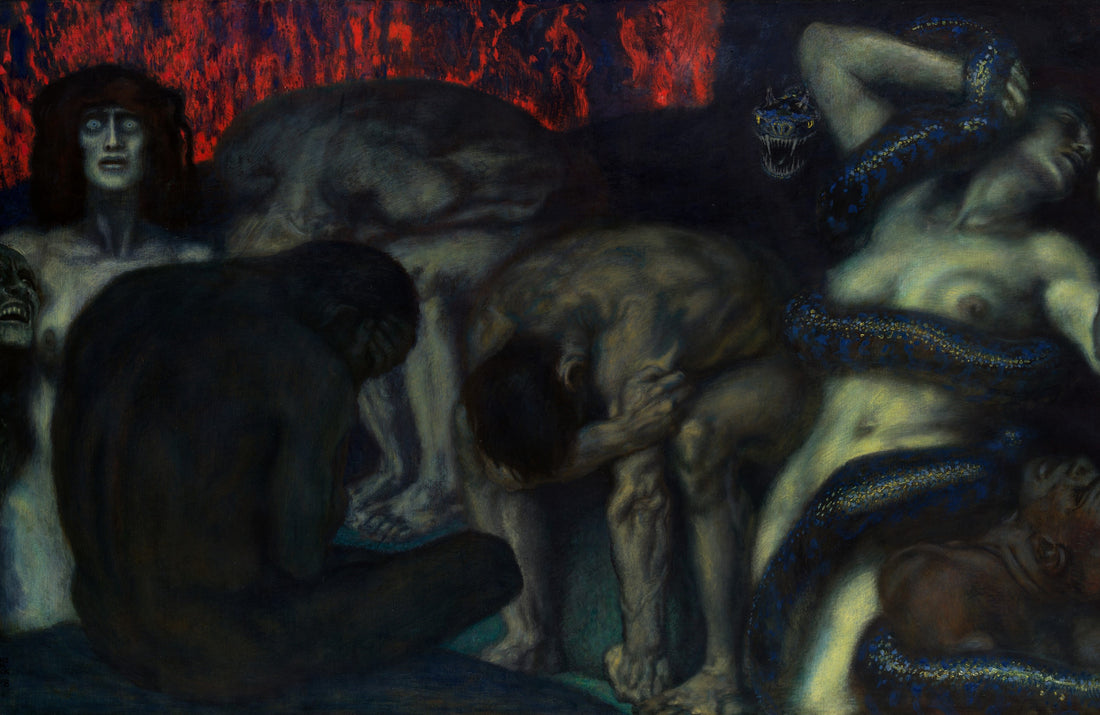
When Inferno reached New York in 1909, reviewers disagreed sharply. The New York Sun dismissed Stuck's paintings as 'melodramatic, false, futile'. The New York Times admired this work's 'unique splendor'. The Metropolitan Museum's history of the painting preserves both responses. The disagreement is understandable: the picture is forceful, crowded and deliberately unpleasant to look at for long.
Painted in 1908, it measures more than two metres across. Six human figures occupy a burning landscape, with a demon at one side and a huge serpent at the other. Its title refers to Dante's journey through hell. The Met's collection entry also suggests an influence from Rodin's The Gates of Hell, particularly The Thinker. The comparison is useful when looking at the bent, inward-looking bodies in the centre.
Begin at the left and move slowly across the painting. The staring woman responds outwardly, while the central figures fold into their own distress. At the right, the serpent tangles with the bodies. Proximity offers no comfort. The people are crowded together, but their poses make each suffering seem private. No one appears able to help anyone else.
Colour adds to that sense of physical discomfort. The red flames and blue serpent stand out against the yellow-green cast of the flesh. Skin looks drained of warmth even beside the fire. The curves of the bodies keep returning the eye to the same confined area; there is little open space to suggest a way out. These are things to look for before trying to identify every figure with a specific character or punishment in Dante.
The frame has its own history. Inferno appeared at the Met in 1909 with a different surround, but by 1914 Stuck had placed it in a frame of his own design. The museum acquired the painting in 2017, more than a century after that first visit. Its return gives the original argument a long afterlife: the picture that some viewers found excessive was also the one they could not easily forget.
Falling Stars: Another Kind Of Night
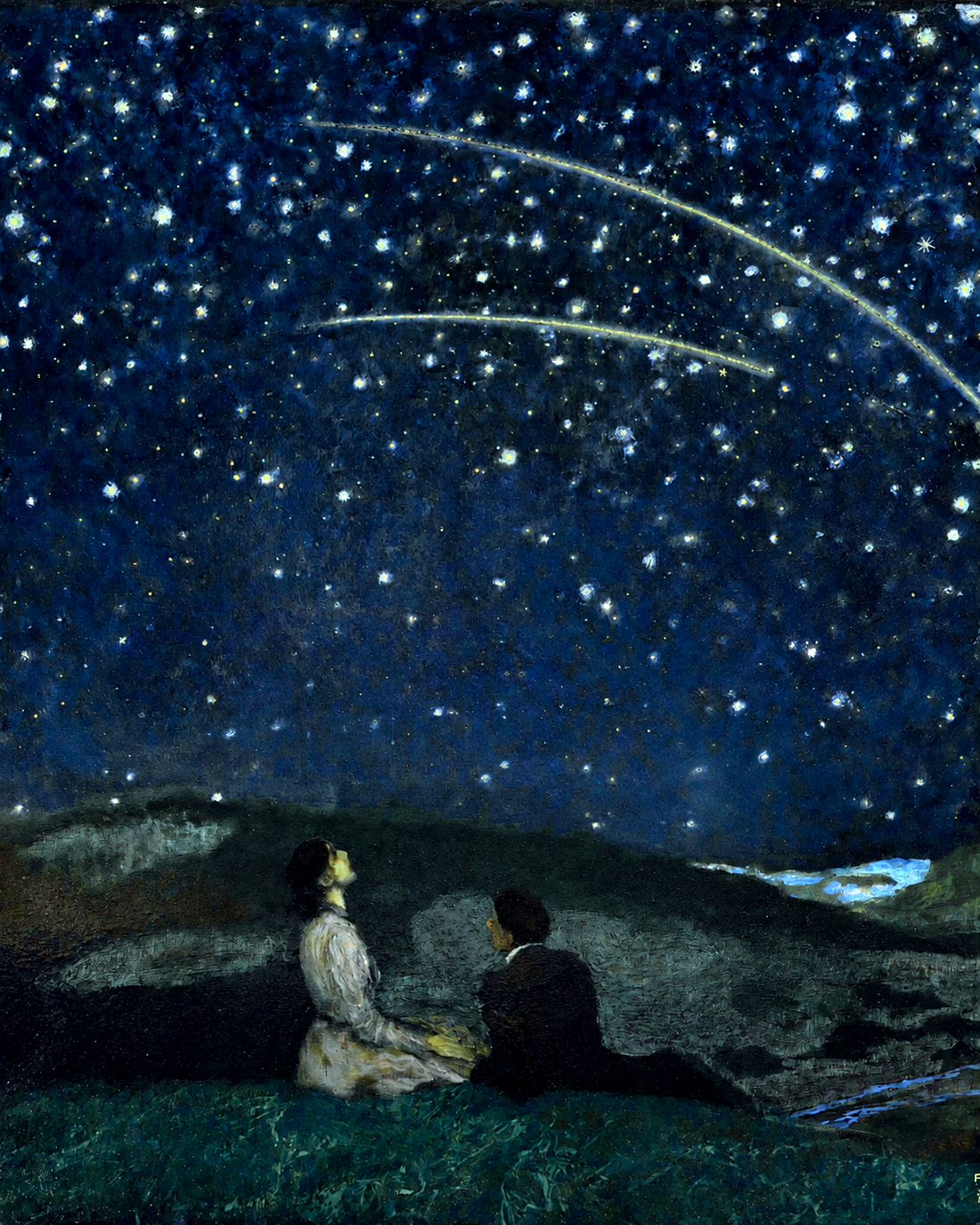
There is a welcome change of pace in Falling Stars. Two people sit beneath an enormous blue sky. The woman looks upwards, while the man turns towards her. The small difference between their directions of attention gives the scene its warmth: they share a moment without looking at exactly the same thing.
The 1912 painting was catalogued by Koller as Sternschnuppen (Franz und Mary Stuck), an identification retained in the auction record. It is oil on wood, measuring 65 by 58.5 centimetres. The personal names make the subject more specific than an anonymous pair of lovers, although they cannot tell us whether the scene records an actual evening.
Look at how much room Stuck gives the sky. The figures occupy the lower part of the picture, leaving the stars and their long trails to dominate. In the earlier paintings, bodies fill the space and press towards us. Here the open area above the couple lets the eye travel. The same painter who crowded the figures of Inferno together now allows his subjects somewhere to look beyond themselves.
The two bright trails are important to the mood. They imply an event that will last only a moment, while the painted image lets us linger over it. Nothing in the couple's posture suggests a dramatic response. Their stillness gives the sky time to hold our attention. The scene feels affectionate without needing an embrace or an exchange of words.
This is a valuable painting to remember when Stuck's reputation begins to seem dominated by snakes, monsters and fatal women. He could use the night for a different kind of intimacy. The human interest here rests in a modest observation: sometimes the most absorbing part of a shared view is the person beside you enjoying it.
The World Around The Picture
Stuck's pictures were often intended to be encountered within surroundings he had helped create. His Munich villa, built in 1897–1898, brought his architecture and interior design together. His furniture won a gold medal at the Paris exhibition of 1900. The museum's chronology makes clear that these activities ran alongside the painting, rather than belonging to a separate career.
The old studio shows how carefully he arranged the experience. Its large window brought northern light into the working area, while paintings and sculptures further inside stood in dimmer surroundings. The room also became a place for exhibitions, sales and formal entertaining. Visitors were entering a setting designed to make an impression, with The Sin eventually occupying the central place in the artist's altar. The Villa Stuck's description of the studio is a useful companion to the paintings.
That concern with presentation is still visible in the individual works. The stag is given a small clearing of light. Medusa's face is enclosed by darkness and snakes. Lucifer's eyes are allowed to reach us before we can properly read his surroundings. Stuck understands how long it takes to notice something, and how much that first impression influences everything that follows.
It is worth returning to the pictures after learning their stories. The snake in The Sin now belongs to an image that stood on an artist's altar. The strained pose in The Kiss of the Sphinx has a preparatory study behind it. The harshness of Inferno has already divided a room of viewers. These details give us more to see. And then there is Falling Stars, where the painter allows a quiet glance between two people to be enough.